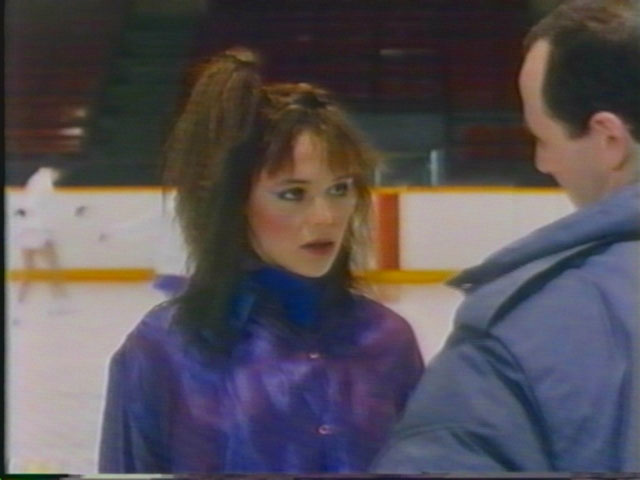
On a clear day in Arborg, Manitoba, I’d have my pick of CBC, CTV, CKND (Global), and MTN. However, most days, it was CBC programming, which explains my love for Degrassi Junior High.
CBC showed memorable movies back then, such as Love and Hate – The Story of Colin and Joanne Thatcher and Loyalties. And the vast majority of Arborg area skaters remember one of the best figure late-1980s skating movies: Skate!
Internationally, the movie was known as Blades of Courage. It stared Christiana Hirt as Lori Laroche, a young talented – and undisciplined – figure skater who won the bronze medal at her first Canadian championships. In a controversial move, the Canadian Figure Skating Association (CFSA) – now the Skate Canada – sent Laroche to the Worlds rather than the silver medallist and female antagonist, Tara Lynn.
After a 10th place finish at the Worlds, the CFSA enlists high-ranking coach Bruce Gainor, portrayed by Colm Feore, to train Laroche with devastating results. Laroche leave her small town and heads to Toronto, Ontario, and she’s surprised Tara Lynn is there as one of Gainor’s students. Gainor deems Laroche’s “arrogant, lazy, head strong..” His goal is for Laroche to land a triple Salchow, win Canadians, and the Worlds. Meanwhile, Laroche is adapting to a gruelling skating schedule, a new school, and Tara Lynn’s antics.
When Laroche can’t land the triple Salchow, Gainer yells at her, “If you fall, you get back up and repeat the jump. Again and again until you get it right.” No surprise, she lands the triple. Fast forward to sections, and she falls and follows Gainer’s instructions. Repeating the jump, again and again. Tossing away her career. Laroche returns home and falls into a depression.
Of course, the movie wouldn’t have a teenage skater cult following without a happy ending. Laroche returns to the ice the following season, and she qualifies for the Canadians. I won’t ruin the rest.
When this movie was released, I didn’t realize a similar incident occurred on Canadian soil.
At the 1980 Canadians in Kitchener, Ontario, spunky 12-year-old Tracey Wainman flew through her long program at lightning speed, leaving an impression on the skating community and the CFSA. She captured the bronze medal with a four-minute program that included a triple Salchow.
It was an Olympic year, and the CFSA made an eyebrow raising decision. They sent the 1980 Canadian champion Heather Kemkaran to the Olympics in Lake Placid, New York, and Wainman to the 1980 World Figure Skating Championships in Dortmund, Germany – formerly West Germany.

Wainman, after placing 21st in the compulsories and 17th in the short program, she was 20th entering the long program. Wainman soared and placed 10th in the long, finishing 14th overall. David Dore, the former head of the CFSA touted her as the future. Kemkaran placed 15th in Lake Placid and turned professional. Wainman won the Canadians in 1981, however, she struggled to live up to the CFSA’s expectations and she stopped skating during the 1983/1984 season. Wainman returned in 1984/85, and the next season she won the 1986 Canadian championships. She placed 9th at the Worlds in Geneva, Switzerland.
However, the CFSA didn’t assign Wainman to any international assignments for the 1986/1987 season – one year from the Olympics. Apparently the CFSA “disapproved of her undisciplined off-ice behavior.” Wainman retired that year.
Another example of slashed dreams, enter a young Emanuel Sandhu who nabbed the silver medal at the 1998 Canadian championships – during an Olympic year – in Hamilton, Ontario. However, the Canadian Olympic Committee refused to send him to Nagano, Japan. While Sandhu met the requirements of the CFSA, he didn’t compete in Grand Prix events that season due to injury. Jeffrey Langdon, the bronze medallist would go in his place. Langdon finished a respectable 12th.
At the 2001 Canadian championships, Nicole Watt gave a spitfire performance to snag the silver medal. However Watt, who lives with Juvenile Rheumatoid Arthritis, was short on international experience. Watt’s hope to skate at the World Championships on home soil in Vancouver, British Columbia vanished. Bronze-medallist Annie Bellemare slid into her place on the world team.
It’s baffling when figure skaters have to wait and see whether they’ve made the world team based on Grand Prix and international results. If a skater wins the gold or silver medal in their country, and it can be a hard climb back.
In the Blades of Courage, of course, Laroche was the protagonist and the silver-medallist was the antagonist. Few want an antagonist to succeed.
However, figure skating isn’t a movie of the week. These are real people with feelings. Their podium finish at nationals should dictate a world or Olympic spot.
Because what hurts the most is someone not believing in you.
Especially your skating federation.

 Skating Scene