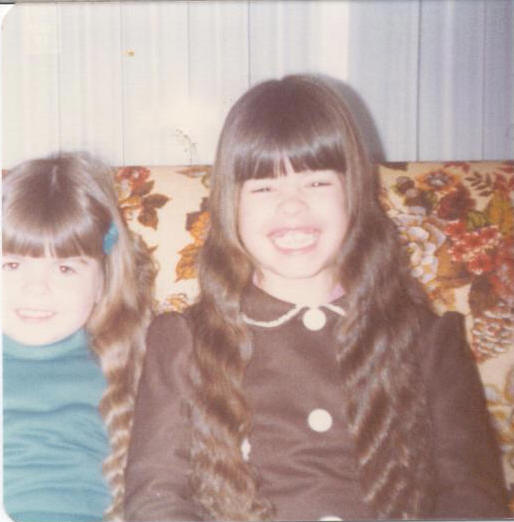
My older sis was a gingerbread girl at the Stroking level.
I was a lollipop at the Beginner level under the N.S.T. stream.
The carnival theme was Days of Wine and Roses.
In my first ice show, I was a lollipop.
All I remember is touching my toes because my long hair fell in front of my face.
I was a Beginner under the National Skating Test (N.S.T.) stream. This changed for the 1983/84 season when the Canadian Figure Skating Association (CFSA, now Skate Canada) rolled out the CanSkate and CanFigure Skate programs – eliminating the 12-badge N.S.T.
Under the N.S.T., skaters were judged by a panel, not the coach. Quite different than its replacement.
The CanSkate stream had eight levels – Beginner, Elementary, Basic, Novice I, II, III, and IV, and Proficiency. Then you advanced to CanFigure or private lessons. There were skaters who stopped taking CanSkate and entered hockey or ringette.
Achieving Novice IV, meant you’d sweat through a Proficiency test, judged by your skating club’s professional coach. Passing Proficiency launched you into the CanFigure program with spins and jumps, plus simple figures and dance. Or you could enter the CFSA’s competitive level for private or group lessons.
At the time, most skaters referred to private lessons as “CFSA,” not private lessons. In CFSA, we required a physical card as proof that we belonged to our club, and this wasn’t required in CanSkate or CanFigure.
While CanFigure and CanSkate were non-competitive programs, under the CFSA’s rules, both programs could compete in precision at certain competitions, and their at their home club competitions.
In private lessons, skaters competed based on their age or test level. There were test days with unseen judges in the stands or standing on the ice, staring at your blade as you etched figures (also called compulsories or patch). Artistic was added in the early-90s. Figures were *eliminated at the senior, junior, and novice levels in 1990. Canada eliminated figures for all levels in during the 1996/97 season and replaced them with a new category called Skills – deep edges, twizzles, brackets, and footwork combinations.
At the time, when you passed a CFSA test, you received a sterling silver pin and a snazzy square badge. The levels – minus figures – are preliminary, junior bronze, senior bronze, junior silver, senior silver, and gold. Dance had an optional diamond. There were nine levels of compulsories: preliminary, then first to eighth figure.
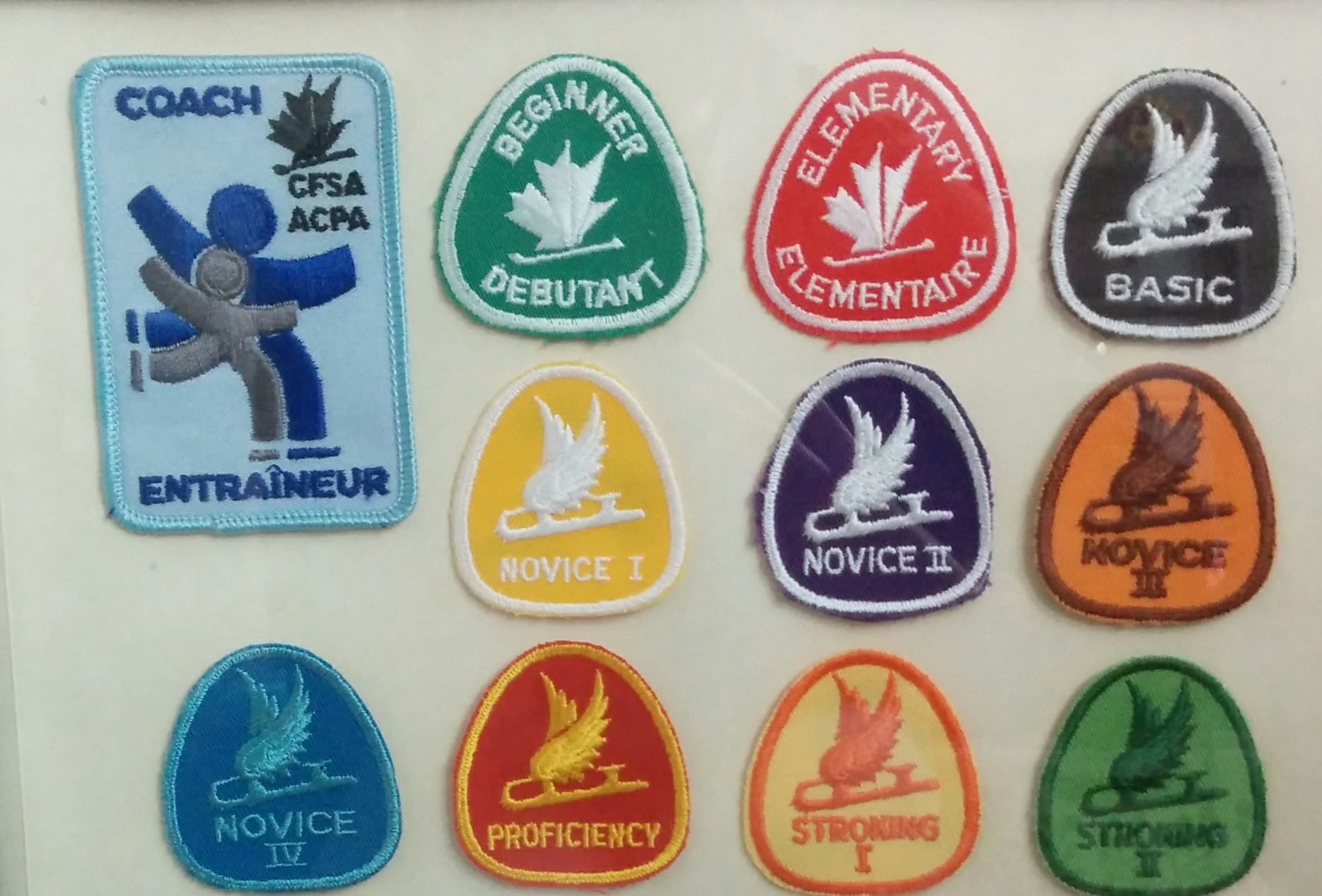
Today’s CanSkate system under Skate Canada doesn’t offer Beginner to Novice IV or Proficiency badges. Instead, they reward ribbons for proficiency in certain areas – such as agility and balance. When a skater conquers the skating skills in their category, they receive a badge, ranging from Level 1 to 6 – different in appearance than the retired Basic or Novice IV badges. When a skater reaches Level 3 or 4, they’re eligible for STARSkate group lessons – similar to the former CanFigure program, now call Bridge Skaters by some clubs.
CanSkate coaching techniques were overhauled too. Rather than groups of freezing skaters with a coach who’s scrambling through a binder for their lesson plan, there are hula hoops and stuffed animals on the ice. Skating instructors use markers to draw the blade placement of a right inside three-turn.
I know this CanSkate system will eventually change too, and some skaters will look back and say, “Well, back in my day … ” However, I prefer CanSkate 2.0 compared to the previous CanSkate program. It’s more efficient. Skaters advance faster. Whereas with Analogue CanSkate, they could outgrow five pairs of skates before passing the Proficiency test.
I was skated under the N.S.T. stream for one season. After three seasons of “retirement,” my sister and I returned to the ice and into CanSkate. By then, the N.S.T was gone, and we were assessed based on skill. My sister was placed in Basic and I was a repeater – Beginner. Only for a couple sessions and I clawed the ladder to Elementary. I never could fall properly. In total, excluding retirement, it took four seasons to finish CanSkate. That may not sound like a long time, but I didn’t learn flips and camel spins until private lessons. The old CanSkate system held skaters back.
I am proud of those retro badges, especially Novice III, IV and Proficiency because I received them within the same week. When I passed the Proficiency test, a friend and I sat on the boards and celebrated by splitting a piece of gum and “toasting” my success and entrance into CanFigure.
I skated with CanFigure for one session after CanSkate since we were in rehearsals for our ice show. Since my CanSkate group number was already planned, I’d be with them – not my sister in CanFigure. However, during that session, I received two CanFigure badges. The next season, I went into private lessons.
The sooner a skater is exposed to higher level jumps, spins, and footwork the better. CanSkate offers a child more than badges and ribbons. It teaches balance, coordination, confidence, discipline, and improves listening skills – plus life long memories, such as the one mentioned with my skating friend and our gum celebration.
Adult skaters aren’t left out in the cold either. Skate Canada offers Adult CanSkate for beginners, and Adult STARSkate for former competitors of all test levels.
There are two skills everyone should have – swimming for safety, and skating for socializing.
When everyone’s on a patch of ice, it’s nice to know you won’t be left out of the loop.
~~~
A modified version of this post will be included in a memoir about my figure skating career in 2025
Updated on December 31, 2023
Source: The Lake Centre News, October 24, 1978

 Skating Scene