At the 1990 World Figure Skating Championships in Halifax, Nova Scotia, Canada, American Champion Jill Trenary won the world title. Japan’s Midori Ito placed 10th in the compulsory figures – unheard of for a defending world champion while Trenary won the segment.
But the original program – or short program as it’s known today – was a different story. After a first place performance, Ito jumped to fourth place overall. However, Trenary downgraded the triple in her triple toe-double toe combo, placing fifth after the original and third overall. Natalia Lebedeva of the USSR sat in first place overall entering the ladies free skate – which became a numbers game.
Both Ito and Trenary needed help from other skaters and each other to clinch the championship. The 6.0 became a “if this skater beats this skater, but places in this position,” situation.
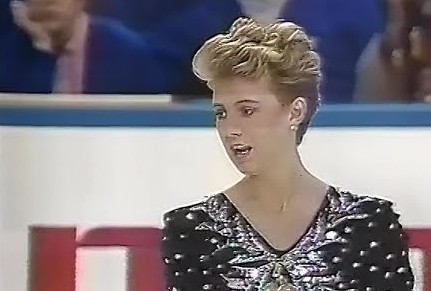
The numbers game calculated in Trenary’s favour, who would win the world title in Halifax, with Ito taking the silver medal. However, Trenary’s comeback wasn’t the only story of the night.
Trenary’s teammate, Holly Cook, a 19-year-old teenager from Bountiful, Utah, made her World Championship debut in Halifax . She quietly sat in second place after the original program – and she’d return home with a bronze medal.
Contrary to popular belief, this wasn’t Cook’s first taste of international victory. In 1986 she won the Coupe des Alpes competition, part of the Nebelhorn Trophy.
Cook competed as a junior in at the 1987 World Juniors, where she placed fourth mere weeks after she competed as a senior at NHK, also placing fourth. On the strength of her compulsory figures, she placed fourth in 1988 and 1989 at the U.S. Nationals. Cook leaped onto the U.S. National World Team for the first time in 1990 to head north to Canada for the World Figure Skating Championships.
After 99 years of slicing of figure eights, the 1990 world would be the last stop for compulsory figures. They were eliminated from competition in most countries at certain levels. However a handful of countries, such as Canada, kept them at lower-level competitions.
A solid compulsory placing could secure a skater’s future in a competition. Cook placed fourth in the compulsories. No one could have predicted how the ladies original program would unfold.
When Holly Cook took to the ice, few knew what to expect from the teenager. Cook had an unusual jumping style. She would press her palm up, turn, and once in the jump she’d press her chin to her chest. Despite a program with minimal choreography, she was a powerful skater with huge double Axels that floated across the ice.
One of the highlights of Cook’s 1990 programs was a travelling two-foot sit-spin that covered the width of the ice. It was a spectacular move that even CBC commentator Toller Cranston said, “that’s a movement that I have not seen for many years. The last skater that did that was Gord McKellen,” the 1973 to 1975 U.S. men’s champion.
Although she lacked the refinement of Trenary, she did what the majority of the ladies that night were unable to accomplish in the original – complete the required elements and stay on their feet. Cook earned a well-deserved standing ovation, and a third-place finish. She headed into the long program in second-place overall – one placement ahead of teammate Trenary.
However, Cook didn’t have the long program of the night. With two triple jumps and sparse choreography, she placed fourth in the segment. Cook was also the final skater and few realized she also need help to stay on the podium. Enter Cook’s teammate, Kristi Yamaguchi.
Yamaguchi watched the scoreboard and saw she was third in the long program, meaning she’d be left off the podium. She need a second place finish in the long program for a bronze. That spot belonged to Trenary, the new world champion.
When Cook looked at the scoreboard, she said to her coach, in disbelief, “I’m in third?” The happiness on her face was indescribable.
During the 1990/1991 season, Cook’s improved her artistry and she place third at Skate Canada. Cook listened to the comments and made drastic changes to her programs. However, with the elimination of the compulsory figures, she became another skater the world lost. At the 1991 U.S. Nationals she was in fourth place before she skated a disastrous long program, placing sixth overall.
Travelling back to Cook’s debut at the 1990 worlds, she showcased her personality. She skated with joy, not bland seriousness that can destroy a skater.
There are some figure skaters who make an impact on the sport. They revolutionize it or they make a statement. Cook’s statement was that brief appearance in Halifax, Nova Scotia where she left her impression on the world, and she showed everyone what it’s like to go out there and not take herself too seriously. And she was rewarded for it.
Talk about making a statement.
~~~~~~~~
Today, Holly Cook-Tanner coaches out of the South Davis Recreation Center in Bountiful, Utah.

