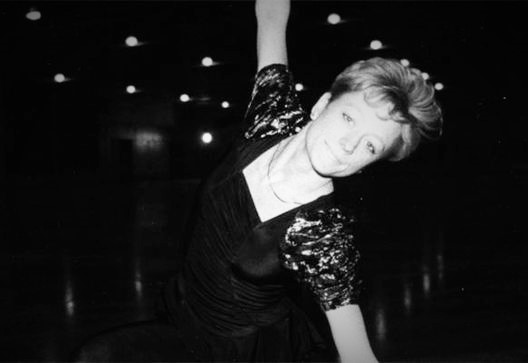
The first Canadian championship I ever watched were the 1989 Canadians from Chicoutimi, Quebec. My older sister and I were at my grandparents’ for the weekend, and we nibbled on Baba’s puffed wheat cake as we watched CKY’s endless hours of coverage.
It was also the first-year Lisa Sargeant-Driscoll burst onto the senior scene. Sargeant-Driscoll, skating as Lisa-Lynn Sargeant at the time, was in seventh place after the compulsories. After a strong short, she moved into fifth.
Donning a purple dress with a crisscross back, covered in sparkles with a bow in her ginger-blonde hair, Sargeant-Driscoll skated to the bronze medal after a second place showing in the free program.
Sargeant-Driscoll grew up in the small town of Alix, two hours south of Edmonton. She describes the village of approximately 830 people as “one of those towns that had a skating rink and a baseball field.
“And I did both,” she said via a phone interview.
At 14 years old, Sargeant-Driscoll moved to Edmonton to train at the Royal Glenora Club and lived with her aunt and uncle.
While she admits moving far from home was “kind of scary,” it was her first experience with “what good ice is like.”
After the 1988 Calgary Olympics, the Canadian Figure Skating Association (CFSA, now Skate Canada) took stock of their up and coming figure skaters. Sargeant-Driscoll was one of them, and she was assigned to the 1988 Golden Spin of Zagreb in the former Yugoslavia.
And she struck gold.
That competition sticks in Sargeant-Driscoll’s mind because there was a sound.
“(I though) What’s that clicking noise?” said Sargeant-Driscoll, and she laughed.
It was cameras from approximately 50 reporters, covering the the event. Sargeant-Driscoll said for some countries a skating competition was treated like a Stanley Cup.
“Here’s a skating competition in the middle of the mountains.”
Sargeant-Driscoll also remembers the people – and children – “dressed in rags.”
She said the experience “made me more appreciative for life.”
The next season, Canada had one entry in the women’s division for the 1990 Worlds in Halifax, Nova Scotia. Sargeant-Driscoll cliched the sole entry, winning the 1990 Canadian Figure Skating Championships in Sudbury, Ont.
Sargeant-Driscoll sees similarities between her personal situation and Kaetlyn Osmond‘s.
“I went to Halifax as the only girl … it was very parallel,” said Sargeant-Driscoll. “It’s perspective.”
Sargeant-Driscoll said it’s pressure, and as long as Osmond can remain calm, she’ll do well.
“Her (Osmond’s) personality seems very easy going.”
At the 1990 Worlds, Sargeant-Driscoll was seventh after compulsories. She sat in sixth after a sixth in the original program. A strong fifth place free program held her sixth place – and an impressive debut for a first showing at the World level.
Sargeant-Driscoll’s placement allowed Canada to send two women to the 1991 Worlds in Munich, Germany – and she was one of them.
However, without compulsories.
Prior to their elimination at the 1990 Worlds, Sargeant-Driscoll would etch figures for up to five hours a day. During the 1991/92 season, Sargeant-Driscoll lost 45-50 per cent of her muscle mass.
Sargeant-Driscoll said no one had prepared skaters for the transition.
“You can only train so long before there’s injury.”
Sargeant-Driscoll said for years the level of skating hasn’t been up to par, skaters ripe with injuries, etc., and it was due in part to the eradication of figures.
“Skate Canada really kind of dropped the ball.”
In competition, Sargeant-Driscoll just wanted to do her best and “that was great.”
Sargeant-Driscoll recalls “pictures and the boards and seeing how exciting my friends were for me.
“I’m more happy for them than me.”
However, one would be hard pressed to find any trace of figure skating in her house, she said. For example, her mom has all of her competition dresses.
“I’ve had to dig my medals out of a box under the stairs,” Sargeant-Driscoll laughed.
“It’s interesting to look back on skating.”
Sargeant-Driscoll remembers the 1994 Canadians in Edmonton – an Olympic year. She said it was really cold, and she didn’t perform her best in her short program.
“I remember my mom told me you don’t get mad in the dressing room, you wait until you get home.”
Sargeant-Driscoll said after the short program, she threw her team jacket over her skating dress and went outside. However, she walked out the doors where the Oilers usually park their bus.
“I couldn’t get back in,” she laughed. “I had to get back in through the front,” Sargeant-Driscoll said. “At least they didn’t ask me for a ticket.”
Sargeant-Driscoll said she’s left the skating part of her life behind. She’s married with two sons, 13 and 16. Sargeant-Driscoll is a teacher in early intervention for children with special needs.
“It’s a sport you get really sucked into.”
Sargeant-Driscoll believes the new system isn’t really that different than the 6.0
“It’s had been a system (where) it really comes down to the short program…it’s not really that different … and you’re favoured … you’re not going to be last.”
Sargeant-Driscoll coached at the Royal Glenora for two years after she retired from figure skating.
“My perspective is a little different,” Sargeant-Driscoll said. “I didn’t just skate there.”
Sargeant-Driscoll said her memories are about the other parts of the club than the rink, such as the tennis courts and the pool.
“It’s really a great facility.”
Some of the best stories, Sargeant-Driscoll said, are with her younger sister, pairs skater Kristy Wirtz. Sargeant-Driscoll describes her sister as a wild child.
“They (pairs skaters) have a real different outlook on life,” Sargeant-Driscoll said. “‘Sure, hurl me to the rafters.’”
The two never competed against each other until the 1993 Wildrose Competition, and Sargeant-Driscoll won.
“And we both knew she (Kristy) should’ve won,” Sargeant-Driscoll said.
One month, Sargeant-Driscoll’s mom received the bill from the RGC – she couldn’t figure out why it was so high. They soon figured out Wirtz was buying ice cream for herself and her friends.
“She (Kristy) got about $500 worth of ice cream charged to our account,” Sargeant-Driscoll said.
Sargeant-Driscoll was frank about figure skating, and where it can take you in life.
“You get so much out of this sport,” she said. “It might not be something skating you get out of it.”
After we spoke, I received a text on my land line. My voicemail read out Sargeant-Driscoll’s top memory from the Royal Glenora Club:
“…would be meeting and falling in love with fellow skater, also known as front desk boy, my husband of 20 years … wouldn’t want to leave that out.”
~~~~~~~~~
Originally posted on the Edmonton Journal website, February 5, 2013
Edits: November 20, 2023
 Skating Scene