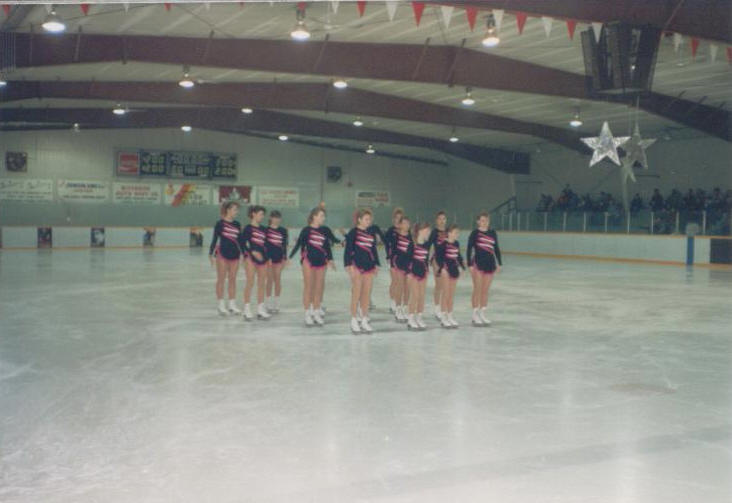
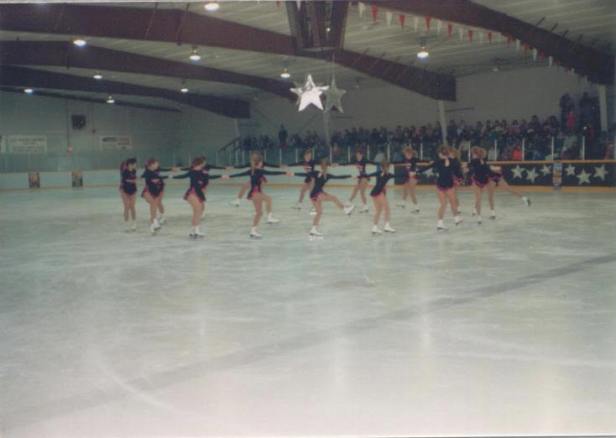
On March 9, 1990, a line of vehicles left the Village of Arborg.
We were heading to the 1990 Interlake Regional Precision Competition in Stonewall, Manitoba. The final competition of the season for our 16-member Arborg Junior team.
The Stonewall Figure Skating Club hosted the competition that warm, spring-like day. It was the finale of a successful season for the Arborg Junior, Juvenile, and CanSkate teams. It also was the Arborg Junior team’s swan song. After searching high and low, merging skaters from three clubs, and pulling skaters out of retirement, our Junior team of sixteen would dissolve after this competition.
None of us were entering the Interlake Regional Precision Competition with an sigh of relief. We were tired, it’d been a long season, especially for skaters balancing singles and precision.
Inside the Stonewall arena, we waited for our teammates and two other Arborg teams. We could smell the aroma of the rink. Most skaters agree arenas have an aroma. It’s fresh and minty. With a hint of ammonia, but that fades. The stench of changing rooms are another story.
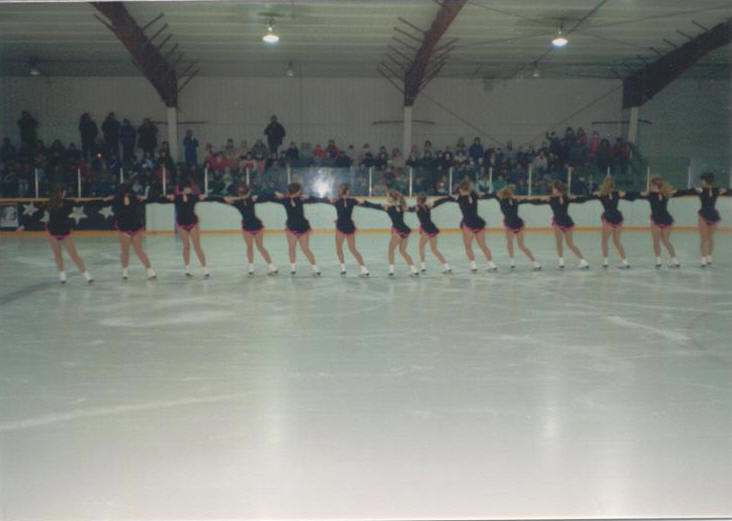
We found our assigned room for the Arborg Junior team. Just the sixteen of us. As we were settling inside, most of us missed the cork board outside our dressing room. It’s also called the competition board, where categories, teams, order of skate and results are posted.
Someone said, “Did you see who we’re up against?”
We were one of two teams in the advanced category. However, we didn’t celebrate a medal by default.
The other team was the St. Andrews Novice Precise-ettes. The best team in our region. One of the top teams in Manitoba. No one in the Interlake dethrones the St. Andrews Novice Precise-ettes.
Yes, the Arborg Junior team were 1990 Manitoba Precision Champions in our division, Recreational C. However, St. Andrews won gold at the 1989 and 1990 Interlake Winter Game trials. In 1989, they placed at the Manitoba Precision Championships in Novice and advanced to the Canadian Precision Championships in Edmonton, Alta.
We couldn’t concentrate on “who” we were against though, because we were competing against ourselves.
The competition was speeding fast. Because of the amount of teams, we’d be skating cold. No warm-up in an unusually warm arena.
The advanced category dropped the curtain on the competition with St. Andrews on the ice first. Giving us time to breathe and share a laugh or two as we lined the hall. Our team stood in our on-ice order, and I was third from the front. I could see St. Andrews’ program through the chicken-wire-covered window in the arena door.
They had poise and grace, they were pure panache. However, to our surprise, a Precise-ette fell. As our team stepped down the concrete stairs, another Precise-ette went down. There was another fall as we all stood at ice level. I glanced at one of my teammates with raised eyebrows.
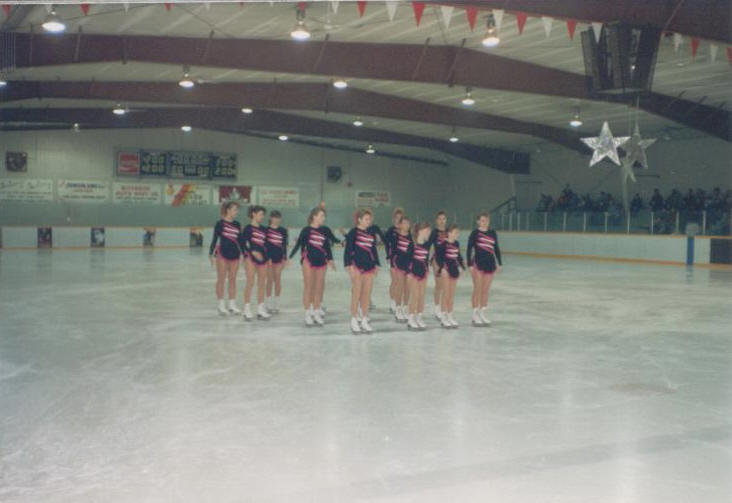
Feb. 11, 1990
St. Andrews looked shocked as they exited the ice. We were shocked. I think everyone in the arena was shocked.
When the P.A. announced our team, and we glided into our entrance block formation. A four-by-four square of skaters. Slap legs, shoulder hold, left leg-right-left, right leg-left-right. Drop arms at corner and regroup, and left leg-right-left.
Maybe we couldn’t match St. Andrews’ technical level or artistic elegance – but we had speed, power, and a funky style. Think Viktor Petrenko and Kurt Browning during the early-90s. We were a team of Kurts.
Our music wasn’t classical or instrumental. Our program began with “Music is the Doctor,” by the Doobie Brothers into Phil Collins, “Thru These Walls,” and “Come Dancing” by The Kinks.

We hit our starting position – an “A.” Yes, “A” for Arborg. I don’t recall much about the program, I’ve heard those are either the best or worst. Considering the reaction from the crowd, it must have been good. One moment stands out. Near the end of the program, we performed a forward, fast-pace, low kickline with a shoulder then our team captain counted down and we dropped into a perfectly timed lunge. Night and day from the above photo.
And no one fell.
After our program, we sat in the changing room. We were fixing our hair. Pretending to dig in our skating bags. Trying to keep busy until the results were posted. But within ten minutes, we were back on the ice for the medal ceremonies with the results shrouded in mystery. Our coach, Joanne, and our team manager were also in the dark.
At the previous Interlake Regional Precision Competition, our team learned we won a silver medal before the ceremonies. Rarely are result an on-ice or near-podium surprise. This felt like the 1988 Winter Games in Calgary when most of the audience didn’t know which Brian – Boitano or Orser – won the gold until the medal ceremony.
Stonewall SC skaters were bring medals out on wooden dowels. The Arborg CanSkate team won bronze, and the Arborg Juveniles won a silver in their respective divisions. A month either, the Juvenile team earn a silver at the Manitoba Provincial Championships. We cheered and started the precision chant of, “We are proud of you, hey, we are proud of you, say.”
The St. Andrews Precise-ettes Novice and the Arborg Junior teams stood side-by-side. St. Andrews seemed less jubilant than the previous season’s Regional ceremony when they were doing the wave.
We were furthest for medal delivery, and we weren’t paying attention to how many categories were in the competition. In 1990, there were at least sixteen precision teams in the Interlake region.
Maybe there was a miscommunication, but during a stretch of silence medals appeared for the advanced category team.
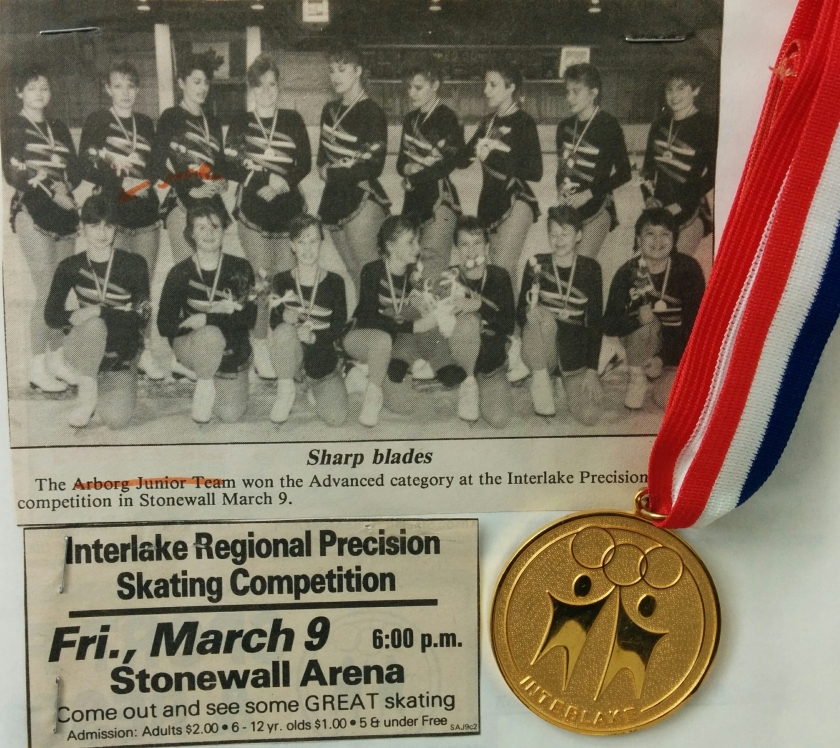
And sixteen faces fell.
Gold medals were facing our team. Some of us glanced at St. Andrews, where there was a row of silvers. We turned and whispered to each other, shrugging our shoulders with a, “What’s going on?” reaction. Fully expecting the Stonewall skaters to switch positions.
Murmurs could be heard throughout the arena. There was even a hesitation before the P.A. announcer said, “And the gold medal in the advanced category goes to … the Arborg … “
Our screams made the rest of the announcement that we’d won the gold almost inaudible.
I’ll never forget the cheers from our families and friends in the stands. Our teammates were hugging each other. One teammate leapt at least 24 inches off the ice before she threw her arms around me. Our coach, Joanne, was on the sidelines, pumping her arms into the air.
We were still hugging and laughing as people from the Stonewall SC awarded our medals, and we were giggling as the Interlake Spectator – our local paper – gathered us together for a photo.
Decades later, I look back on that moment, and it’s one I wish I could relive. Not because of who we overcame, but what our team overcame to win.
Joanne was waiting in our changing room- and she was crying and hugging people, saying how proud she was of us. When she left, our team was buzzing, talking about our season, winning provincials. A teammate said, ” … and our name was in the Free Press,” Manitoba’s largest newspaper. At that time, when you live in a small town – a village – and your precision team’s name appears on the same page as NHL scores, it’s a thrill.
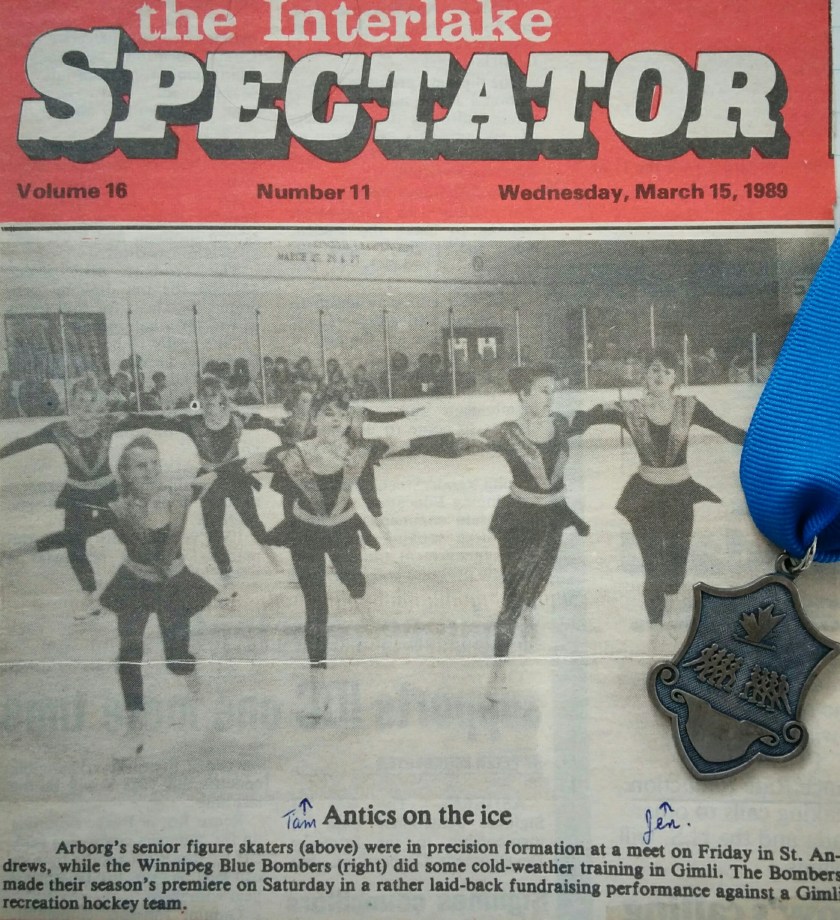
My first precision competition was the 1989 Interlake Regional Precision Competition on March 10, 1989 – 35 years ago today. One season later, we regional champions – and provincial champions. If we’d won the silver at the Interlake Winter Games, the rules wouldn’t have allowed us to attend provincials.
The 1990 Interlake Regional Precision Competition was bittersweet though.
It was still daylight as when we left and arrived home. We were happy, ecstatic, name the adjective. However, it didn’t hit me until the next competitive season that my precision days were over.
Some of the Arborg Juniors hung up their competitive skates, a couple for the second time. Some of the older girls stopped skating. Those of us who continued skating focused on singles. A handful of our younger members balanced both disciplines.
Sometimes, I wonder if the 1990 Arborg Junior team ever thinks about that season. I hope the answer is once in awhile.
Especially that day in 1990, when the impossible became possible.
~~~~~~~~~~
A modified version of this post will be included in a memoir about my figure skating career and published in 2026
In 1998, synchronized skating replaced the term precision, a sport founded in 1956. When these posts reference a team who skated prior to 1998, precision will be used for historical and preservation purposes.
(Resource: US Figure Skating)
Photos: Family archives, 1990 Arborg Skating Club ice show, Movie Mania
Newspaper clippings: Interlake Spectator
Arborg officially became a town in November 1997


